
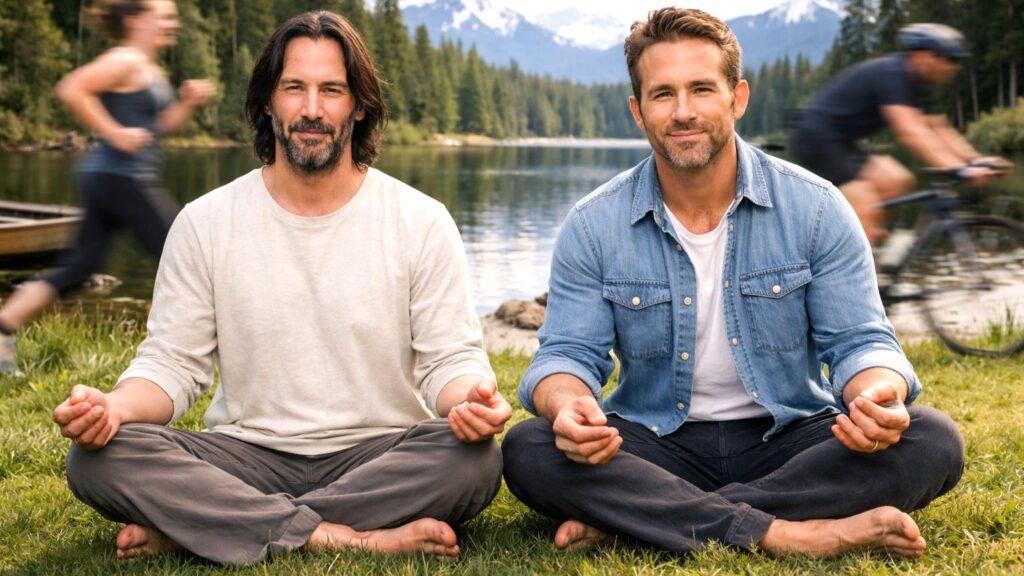
In a World That Moves Too Fast (How to Slow Down Without Dropping Everything)
slow down in a fast world. In a world that moves too fast, the strangest questions sometimes arrive in the quietest moments.
It might come while you’re waiting for a kettle to boil, standing at a red light with your phone still in your hand, or opening a new tab on your browser and then forgetting why you did it. The question isn’t loud, and it doesn’t feel urgent. It just slips in, almost shyly:
“When did everything start feeling like this?”
Not exactly bad. Not exactly good. Just… fast. Blurred. As if your life is scrolling past you quicker than you can read it, and you keep telling yourself you’ll really start living “once things calm down a bit.” But they never do.
This story is inspired by that feeling—and by the way certain people, like Keanu Reeves and Ryan Reynolds, have become quiet symbols of moving a little slower in a world that keeps speeding up. Not as heroes, not as saints, but as reminders: human lives can be lived differently, even when the entire culture is pressing the gas pedal.
But this isn’t really a story about them.
It’s a story about you. Or someone very much like you.
The Night-Time Realization: “I Was Busy… But Did I Live?”
There’s a moment many people share without talking about it. It happens alone, late at night, when you finally put your phone on the nightstand and the room goes dark.
You lie there and realize:
“I was moving the entire day… but did I actually live any of it?”
You remember pieces:
- the rush to get ready
- the quick breakfast eaten while scanning notifications
- the commute with music in your ears but your mind already in the day’s problems
- messages replied to half-thoughtfully
- meetings where you nodded and contributed, but a part of you watched yourself from a distance—like someone in a video on fast forward
You remember laughing at something online. Feeling annoyed at a comment. Opening an app again without even realizing you had already checked it a minute ago.
The day was full. And yet, something feels empty.
“My life is happening. I was there. But why does it feel like I’m missing it while it’s happening?”
The feeling is quiet—but it’s heavy.
A Quiet Moment That Changed Something: Keanu’s Pause
One evening, after a day that felt particularly fast and particularly thin, you found yourself watching a clip of Keanu Reeves being interviewed.
The interviewer asked a simple question:
“What do you think happens when we die?”
Keanu paused.
He didn’t rush to fill the silence. He didn’t try to sound clever. He just sat there, thinking. The silence wasn’t awkward—it was honest, like he was allowing the weight of the question to exist.
Then he said:
“I know that the ones who love us will miss us.”
No theories. No big claims. Just something grounded, gentle, and real.
And you felt something inside you tilt a little—because that pause, that unhurried presence, felt like the very thing missing from your days.
It made you wonder:
“What would my life look like if I allowed more of those pauses?”
Ryan Reynolds and the Permission to Admit You’re Overwhelmed
Not long after, you came across Ryan Reynolds talking about anxiety and pressure.
You expected humor—and there was humor—but what stayed with you was the way he talked about fear and that restless sense that you’re always behind, no matter what you accomplish.
He talked about using humor to cope. To survive. To move through social situations that felt overwhelming.
No dramatic “overcoming.” No performance of victory. Just the calm truth:
“This is something I live with.”
Listening to him, you felt a quiet permission forming in yourself:
- permission to admit you also feel overwhelmed
- permission to notice how anxiety hides under productivity, scrolling, sarcasm, or nonstop work
- permission to be honest about the tension you carry before the day even begins
And slowly, another question formed:
“How do I slow down… without dropping everything?”
You Don’t Need a New Life—You Need a New Way of Moving

Most people’s lives aren’t built for sudden drastic change.You can’t just quit your job. You can’t disappear to a cabin. You can’t throw your phone in a river and move to a monastery.You have responsibilities. Bills. People who need you.So you tell yourself you’ll just push through. Optimize. Become more productive. Get everything under control—then you’ll relax.But deep down, you sense the trap:
- the more productive you become, the more you’re asked to produce
- the more reachable you are, the more people reach for you
- every gap in the day gets filled with something—notifications, tasks, videos, noise
You don’t need a new life.
You need a new way of moving inside the life you already have.
The Experiment: One Slow Thing a Day
You began an experiment. Not dramatic—quiet.
Rule #1: Do One Thing Slowly (On Purpose)
Once a day, for just a few minutes, you would do one thing slowly.Not wisely. Not productively. Just slowly.You chose drinking your morning coffee.
Instead of grabbing it on the way to your screen, you sat down with it. You held the warm cup with both hands. You noticed the smell. The temperature. The taste.At first, it felt almost wrong—like you were stealing time from your to-do list. Your mind itched to pick up your phone.But you stayed with it.You didn’t become enlightened. Your problems didn’t evaporate. But something small shifted:For a few minutes, your life wasn’t rushing past you.You were there.
The Second Experiment: Finish One Thing Before the Next (Especially on Your Phone)
Rule #2: Stop Scattering Your Attention
You noticed how often your phone pulled you into a chain like this:
Message → Notification → Another app → Link → Half-read article → Shopping app → Forget why you picked up the phone.
It wasn’t your brain being broken.
It was your attention being constantly pulled.
One day, you caught yourself with four open conversations, a half-read article, and the empty feeling of:
“What am I even doing?”
So you tried something tiny:
You put the phone down for ten seconds.
Then you picked it up with one intention:
“I am just going to read this one message and reply.”
You read it. You replied thoughtfully. Then you stopped.
No one else noticed—but you did.
It felt like reclaiming something important:
your attention—your life’s most basic currency.
The Surprise: The World Doesn’t Punish You for Slowing Down
You still had bad days. You still rushed. You still got pulled into scrolling. You still snapped sometimes when stressed.
But each time you slowed down for even a few minutes, you noticed something important:
The world outside didn’t punish you for it.
- emails were still there after your slow coffee
- messages still waited when you took a pause
- you didn’t lose your job, your friends, or your place in the race
If anything, you responded more clearly. More kindly. You made fewer mistakes. You felt less scattered—even if only slightly.
You started understanding something Keanu’s presence hinted at:
Slowness is not the opposite of strength. It can be a form of strength.
And something Ryan’s honesty reminded you:
Naming your inner chaos can be the first step to walking gently with it.
A New Skill: Acknowledging Anxiety Instead of Running From It
Some mornings you’d wake up and realize:
- your heart is already racing
- your mind is listing what can go wrong
- your shoulders are tense before you’ve even started
Instead of distracting yourself immediately, you tried something new:
“Okay. I’m anxious today. That’s what’s here.”
One slower breath. Then another.
You didn’t shame yourself. You didn’t try to “fix” it instantly.
You simply let it be real.
And strangely, that acceptance made it slightly less suffocating—like anxiety was weather, not a life sentence.
This was a kind of slowing down too:
slowing the rush to judge yourself.
What Changed Over Time (Without Changing Your Whole Life)
Over weeks and months, your days didn’t become magically calm.
But your relationship with them changed.
You started to:
- walk a little slower when you didn’t absolutely have to hurry
- look people in the eye a moment longer when they spoke
- pause before sending messages and ask, “What do I actually mean?”
- listen more fully—and notice conversations feel less shallow
You still admired achievement and success—but speed stopped being the only measure of worth.
Some things grow better with time and care:
a conversation, a relationship, a skill, a moment with yourself.
The Small Moment That Proved Everything

One day, you were standing in line somewhere—a grocery store, a café, it doesn’t matter.In the past, this would have been dead time, filled with a quick check of your phone. Your hand reached for your pocket.Then you paused.Your hand hovered there like a habit caught mid-air.
Instead of pulling your phone out, you let your hand fall back to your side.You looked around:
- the cashier chatting with the person ahead
- late-afternoon light sliding across the floor
- a child humming a simple, tuneless melody
- someone behind you already scrolling
Nothing extraordinary was happening.
But you were there for it.
Fully.
And you realized something:
This tiny, ordinary moment was… enough.
Not spectacular. Not content-worthy. Just real.
And that might be what you’d been missing.
The Truth You Learn When You Slow Down
Over time, a few simple truths started to form—not like motivational slogans, but like lived wisdom:
- You don’t have to escape your life to slow down. You can begin with one breath, one sip, one small act of attention.
- You don’t have to become someone else. You can carry anxiety, ambition, restlessness—and still move gently.
- You don’t need a grand reason to pause. Being alive is reason enough.
You also stop believing your worth is measured by:
- how quickly you respond
- how much you produce
- how constantly available you are
Instead, you begin to see something deeper:
Your worth has something to do with your presence.
A Soft Ending (And a Real One)
That pause Keanu took before his answer.That honesty Ryan showed about anxiety.The small slow moments you started giving yourself.Together, they form a different kind of wisdom—quiet, but lasting.Your life is not a race to be won.
It’s a story to be lived.
And if the world is moving too fast, you are still allowed to move gently.
You are allowed to:
- put down your phone at the red light and just wait
- take a breath before answering
- drink your coffee slowly
- feel your fear and still go on
- be here—fully—even if only for a moment at a time
In the end, when someone thinks of you and misses you—as Keanu so simply reminded—it won’t be because you replied quickly, or stayed constantly busy, or kept up with every wave of the world.
They will miss the way you made them feel when you were truly there.And that presence—that quiet, real presence—is something you can practice now, in small ways, without changing your entire life.Just a slightly slower breath.Just a slightly kinder pace.Just a gentle refusal to let the world’s speed decide the speed of your soul.