
Introduction: A Quiet Act of Kindness That Changed Everything
The day the elderly waitress lost her job, she didn’t even recognize the quiet customer she was trying to serve with kindness.
He stood just inside the diner’s back hallway, half-shadowed by the stainless-steel shine of the kitchen doors. A black cap pulled low. A dark T-shirt. Tired eyes that looked like they’d been carrying too much for too long. He wasn’t loud. He wasn’t demanding. He didn’t announce himself the way important people usually did.
He simply waited, hands in his pockets, as if he’d rather disappear than be noticed.
Margaret had been a waitress for nearly forty years—long enough to read people the way some folks read menus. And when she looked at this quiet man, she didn’t see fame. She saw someone hungry, not just for food, but for a moment of normal life.
Her knees ached as she walked toward him. The soles of her shoes were worn thin, and the blue uniform she wore—neatly pressed, always—made her feel like a relic from a different era. The name tag pinned to her chest said “Margaret” in simple black letters, though most customers called her “ma’am” or “miss” without really seeing her at all.“Are you waiting for a table, honey?” she asked.
The man lifted his head slightly, and his face came into clearer view. Margaret felt a faint jolt in her chest—not excitement exactly, but recognition, like a song you haven’t heard in years suddenly playing on the radio.It was him.Keanu Reeves.
And for a second, Margaret forgot to breathe.He gave her a small, almost apologetic smile. “If it’s not too much trouble,” he said softly, “I’m just looking for something quick. Somewhere quiet.”Margaret glanced toward the dining room. Lunchtime was close, and the front was already filling with chatter and clinking plates. Quiet didn’t exist in that space—not unless you created it.
elderly waitress lost her job
“We’ve got a small corner booth,” she said, already deciding. “It’s not fancy, but it’s yours if you want it.”He nodded like she’d offered him something far bigger than a seat. “Thank you.”
Margaret led him through the narrow aisle, away from the busiest tables, to a booth that sat near the wall, half-hidden by a fake plant that had survived more years than most employees. It wasn’t a VIP section. It was simply where Margaret put people who looked like they needed a little mercy.
She handed him a menu, but he barely glanced at it.
“Coffee,” he said. “And whatever you think is good.”
Margaret smiled, the kind of smile that comes from old habits and old kindness. “Then you’re getting the pot roast special. And a slice of pie if the kitchen hasn’t burned it today.”
He chuckled under his breath. “Sounds perfect.”
As she walked away, she told herself she wouldn’t make a big deal of it. She wouldn’t stare. Wouldn’t whisper to the other servers. She’d treat him like she treated everyone else—like a human being.
But somewhere inside her, a quieter part of her heart stirred. Because Margaret knew what it meant to be exhausted. She knew what it meant to be seen only for what you could give, never for who you were.
And she had a feeling he might know that too.
The Rule That Broke Everything
Margaret’s diner wasn’t the kind of place that liked attention.
elderly waitress lost her job
It survived on regulars—construction workers, retired couples, tired nurses on short breaks. The owner, Mr. Harlan, ran it with tight rules and an even tighter temper. He believed kindness was something you offered only when it didn’t cost you anything. He believed staff should “know their place.” He believed, above all, that problems were always caused by someone else.
One of his rules—spoken and unspoken at the same time—was simple: no special treatment.
Not because he respected fairness, but because he hated anything he couldn’t control. Celebrities brought attention. Attention brought questions. Questions brought the kind of chaos that made a man like Mr. Harlan feel small.
So when Margaret told the kitchen to take extra care with the pot roast—“not extra food,” she insisted, just “extra care”—she did it quietly. When she warmed the pie slightly and added a small swirl of whipped cream, she did it without thinking.
That’s what you do for someone who looks like they’ve forgotten what warmth feels like.
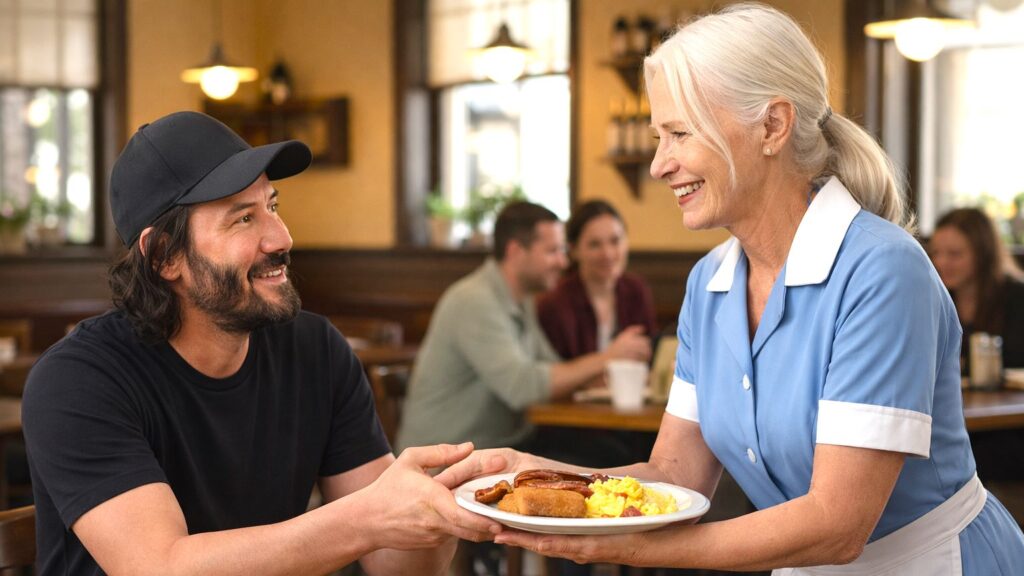
Keanu ate slowly, looking around the diner as if he was taking in the ordinary beauty of it. He thanked Margaret every time she came by. He asked her how her day was. And when she answered, he listened—not the way customers pretend to listen while their eyes wander, but with focus, like her words mattered.
“You’ve been doing this a long time,” he said, noticing the slight tremble in her hands when she poured his coffee.
“Long enough to know where all the loose tiles are,” Margaret replied.
He smiled. “Do you like it?”
Margaret didn’t want to lie. Not to him.
“I like people,” she said carefully. “I like feeding folks. But… it’s hard sometimes. Harder lately.”
He nodded as if he understood that sentence better than most. “Yeah,” he said softly. “I get that.”
When he finished, he reached for the check. Margaret brought it over, and he placed his card on the tray without looking at the amount.
Then Mr. Harlan appeared.
He didn’t walk up like a manager checking in. He marched up like a man arriving at a crime scene, eyes sharp and jaw clenched. Margaret saw the moment his gaze landed on Keanu’s face. Recognition flashed—followed immediately by something uglier than surprise.
Fear.
Not fear of Keanu, exactly. Fear of what Keanu represented: attention, power, the kind of person the world listened to.
“Sir,” Mr. Harlan said, voice tight. “I’m going to have to ask that you—”
Keanu looked up calmly. “Everything okay?”
Mr. Harlan forced a smile that didn’t reach his eyes. “We have policies here. We don’t allow—well, we don’t allow disruptions.”
Margaret stepped in quickly. “He hasn’t disrupted anything,” she said, her voice gentle but firm. “He’s been quiet. He just wanted lunch.”
Mr. Harlan turned toward her so fast it felt like the air snapped. “Margaret,” he said in a low warning tone. “Go to the back.”
Her stomach dropped. She’d heard that tone before. It meant humiliation was coming, and it would be public if he could make it so.
“Please,” Keanu said, standing now, calm but unmistakably present. “She’s been wonderful. I’m just eating.”
Mr. Harlan’s face tightened further, and he glanced around the diner, as if searching for eyes that might be watching.
Then he did what bullies often do when they feel cornered.
elderly waitress lost her job
He blamed the easiest target.
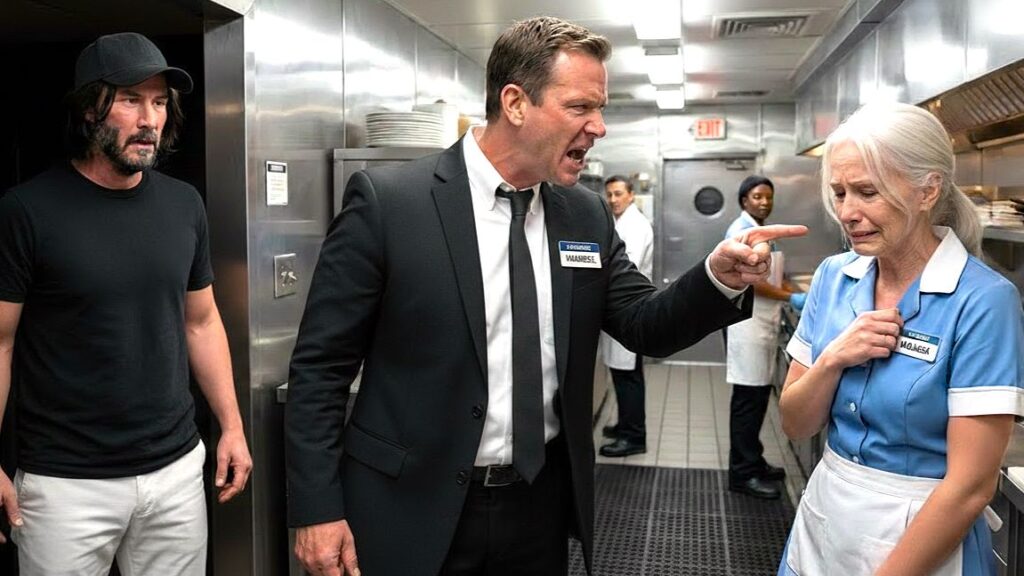
In the back hallway, where the kitchen noise echoed against steel walls and the air smelled like hot oil and onions, Mr. Harlan pointed a finger inches from Margaret’s face.
“You think you can just do whatever you want?” he snapped. “You gave him extra. You comped dessert. You think I don’t know?”
Margaret’s throat tightened. “I didn’t comp anything,” she whispered. “I just—served him. Like I serve everyone.”
Mr. Harlan’s voice rose. “Don’t lie to me. You want to play hero, you do it on your own time. You’re done here.”
Margaret blinked, certain she’d misheard. “I… I’m done?”
“You’re fired,” he said, loud enough for the nearest cook to glance over. “Hand in your apron. Now.”
The hallway felt smaller suddenly, like it was closing in.
Margaret’s hands went numb as she untied her apron. She thought about her rent due next week. About the medication she bought in halves because full prescriptions cost too much. About the little envelope in her purse with cash for her grandson’s school trip—money she’d saved coin by coin.
Her eyes burned, and she hated herself for it. She hated crying in front of people. Hated giving someone like Mr. Harlan the satisfaction.
But tears came anyway, hot and unstoppable.
And then she heard footsteps behind them.
Slow. Steady.
Keanu had followed.
The Moment No One Expected
Mr. Harlan straightened like he’d been caught stealing. “Sir, you can’t be back here,” he said quickly, switching to a fake politeness that sounded like choking.
Keanu didn’t raise his voice. He didn’t puff up. He simply looked at Margaret—really looked at her—and then at Mr. Harlan.
“You fired her,” he said, not as a question.
“She violated policy,” Mr. Harlan replied, trying to regain control. “We have standards.”
Keanu’s eyes didn’t harden, exactly. They deepened, like still water turning serious. “Your standard is firing an elderly woman for being kind.”
Margaret tried to wipe her face, embarrassed. “It’s okay,” she whispered, though it wasn’t.
Keanu stepped a little closer, careful not to crowd anyone. “No,” he said gently. “It’s not.”
Mr. Harlan let out a sharp, humorless laugh. “Look, sir, I’m sorry if this makes you uncomfortable, but this is my business.”
Keanu nodded once. “You’re right. It’s your business. And you can run it how you want.” He paused, letting the silence do the heavy lifting. “But I can also choose where I spend my money. And where people I know spend theirs.”
Mr. Harlan’s face flickered.
Keanu reached into his pocket and pulled out his phone. He didn’t film. He didn’t threaten. He simply made a call.
Margaret didn’t hear the full conversation—just pieces.
A name. A quiet request. A promise to send details.
When Keanu hung up, he looked at Margaret again. “What’s your last name?” he asked.
Margaret hesitated. “Why?”
“Because,” he said, voice steady, “I want to help you. And I want to do it the right way.”
Mr. Harlan scoffed. “This is ridiculous. You can’t just—”
Keanu turned toward him. “I can,” he said simply. Not arrogant. Just factual. “And I will.”
Margaret’s cheeks flushed with confusion and shame. She didn’t want charity. She wanted dignity. She wanted to earn her way the way she always had.
“I don’t want trouble,” she whispered.
Keanu’s expression softened. “Neither do I,” he said. “I just want you to be treated like a person.”
Mr. Harlan threw his hands up. “She’s old,” he snapped. “She can’t keep up anymore. I’ve been doing her a favor keeping her around.”
Margaret flinched like he’d slapped her.
Keanu’s voice remained calm, but it carried something unshakable. “You didn’t keep her around as a favor. You kept her because she showed up. Because she worked. Because she cared.” He glanced at Margaret’s trembling hands. “And you fired her because kindness made you feel out of control.”
The kitchen seemed to hold its breath.
elderly waitress lost her job
Then Keanu turned back to Margaret. “Do you have somewhere to go right now?” he asked.
Margaret nodded automatically. “I… I can take the bus.”
Keanu looked at the hallway, the harsh fluorescent lights, the older woman who’d just been torn apart for doing something decent. “Not today,” he said.
A Door Opens Where She Expected a Wall
What happened next didn’t feel real to Margaret—not in the way movies don’t feel real, even when you’re living inside them.
elderly waitress lost her job
Keanu didn’t hand her a stack of cash and disappear into a black car. Instead, he asked questions. Quiet questions that sounded like respect.
Where do you live? Do you have family nearby? What do you need this week?
Margaret tried to resist. Pride is a stubborn thing, especially when it’s all you have left.
But Keanu’s kindness wasn’t loud. It didn’t demand gratitude. It didn’t come with a camera or a speech. It came like a warm coat placed gently around your shoulders when you didn’t realize you were freezing.
That afternoon, he arranged a ride for her home. Not a flashy one—just safe. He told her he’d cover her missed wages for the month while she figured out her next step. Margaret protested until her voice cracked, and then she stopped because she realized she wasn’t arguing with a man trying to feel important.
She was arguing with someone who meant it.
Before he left, he asked her one last question.
“What did you want to do before life got so heavy?” he said.
Margaret stared at him. No one had asked her that in years. People asked her what she served. What time she clocked in. Whether table six needed a refill.
But not that.
“I used to bake,” she admitted, voice small. “I was good. My husband said I could’ve had my own little shop. But… bills happen. Then he got sick. Then…” Her voice drifted into silence.
Keanu nodded slowly, as if filing her words somewhere sacred. “What if you baked again?” he asked.
Margaret let out a sad laugh. “With what money?”
Keanu’s gaze didn’t waver. “We’ll figure it out.”
And somehow, for the first time in a long time, Margaret believed someone.
The Turning Point That Changed Her Life
The weeks that followed felt like waking up after years of sleep.
elderly waitress lost her job
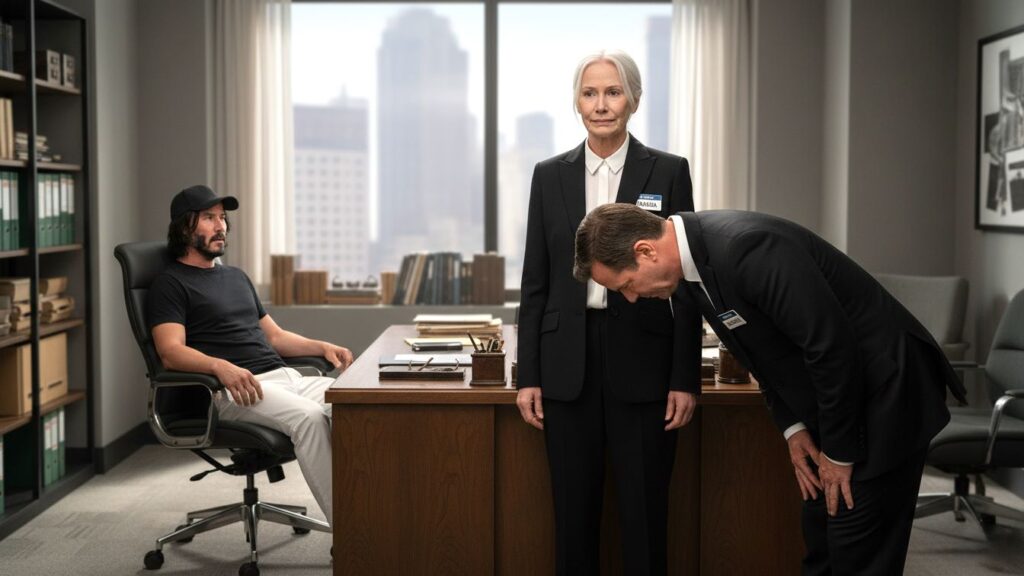
Keanu connected Margaret with a local community program that helped older workers restart careers and small businesses. He didn’t do it by “saving” her; he did it by opening doors and letting her walk through them with her head high.
He helped her find a small commercial kitchen she could rent a few hours a week. He paid for the first months quietly, through a manager who kept everything professional. He made sure Margaret had legal advice, so she wasn’t taken advantage of. And when she insisted she would pay him back, he agreed—but in the way kind people agree when they want you to keep your dignity intact.
Margaret started baking again.
At first, it was just pies—apple, pecan, cherry. Then cakes. Then trays of cinnamon rolls that made neighbors knock on her door “just to say hello.” Word spread the way real word spreads: person to person, heart to heart.
A local café began selling her desserts. Then another.
Margaret designed a small label with her grandson on a laptop, both of them hunched over the screen like co-conspirators. The label read: “Margaret’s Kitchen.”
One night, after a long day of baking, she sat at her tiny table with her hands wrapped around a cup of tea, and she cried again.
But these tears were different.
These were tears of relief.
Because losing her job had felt like the end of her usefulness, the final proof that the world had no place for her anymore.
And yet here she was—building something new at an age when most people only talked about what they used to be.
A few months later, a letter arrived in the mail. It was an official notice about the diner.
Mr. Harlan’s business had been inspected after complaints—complaints that didn’t come from Keanu directly, but from the attention his presence had triggered. Staff members spoke up. Customers spoke up. Things that had been ignored for years were suddenly seen.
Margaret read the letter slowly, not with revenge in her heart, but with a strange peace.
elderly waitress lost her job
Because it wasn’t about Mr. Harlan falling.
It was about Margaret rising.
The Kindness That Echoes
Margaret never became “rich,” not in the way the world measures it. She still watched her spending. Still patched old sweaters. Still clipped coupons out of habit.
But she became secure.
elderly waitress lost her job
She paid her rent on time. She filled her prescriptions without cutting pills in half. She helped her grandson take that school trip—and then another. She donated pies to church fundraisers and food drives, not because she had to, but because she remembered what it felt like to be scared.
Every now and then, she’d receive a simple text from an unknown number.
“How’s the baking going?” it would read.
And Margaret would smile, wiping flour off her hands before replying.
“It’s going,” she’d type back. “And I’m still good.”
Keanu never asked for public credit. He never turned her life into a headline. He simply did what so many people forget to do.
He saw her.
And because he saw her, she began to see herself again too.
elderly waitress lost her job
Conclusion: When One Kind Choice Rewrites a Life
People like to believe life changes only through big moments—grand speeches, dramatic rescues, perfect luck. But Margaret learned something quieter and more powerful.
elderly waitress lost her job
Sometimes life changes because a tired man walks into a diner looking for peace, and an elderly waitress decides to treat him like a human being.
Sometimes life changes because someone with influence chooses not to look away when injustice happens right in front of them.
And sometimes the most painful ending—being fired, being shamed, being made to feel disposable—is actually the universe clearing space for a beginning you didn’t think you deserved anymore.
Margaret still remembered the sting of Mr. Harlan’s finger pointing at her, the heat of humiliation rising in her face, the awful thought that she was too old to start over.
But that memory no longer defined her.
What defined her now was the smell of cinnamon in the morning. The weight of a pie box in her hands. The pride in her grandson’s voice when he told people, “My grandma made that.”
And the quiet truth she carried like a light inside her: kindness is never small. It travels. It echoes. It returns.
Because one day, when the world tried to throw Margaret away, a stranger reminded her she still mattered.
And that reminder didn’t just change her week.
elderly waitress lost her job
It changed her life.
Disclaimer
This blog post is a fictionalized story inspired by the provided title and image. It is created for entertainment and motivational purposes and does not claim to describe real events or verified actions of any individual or business.